
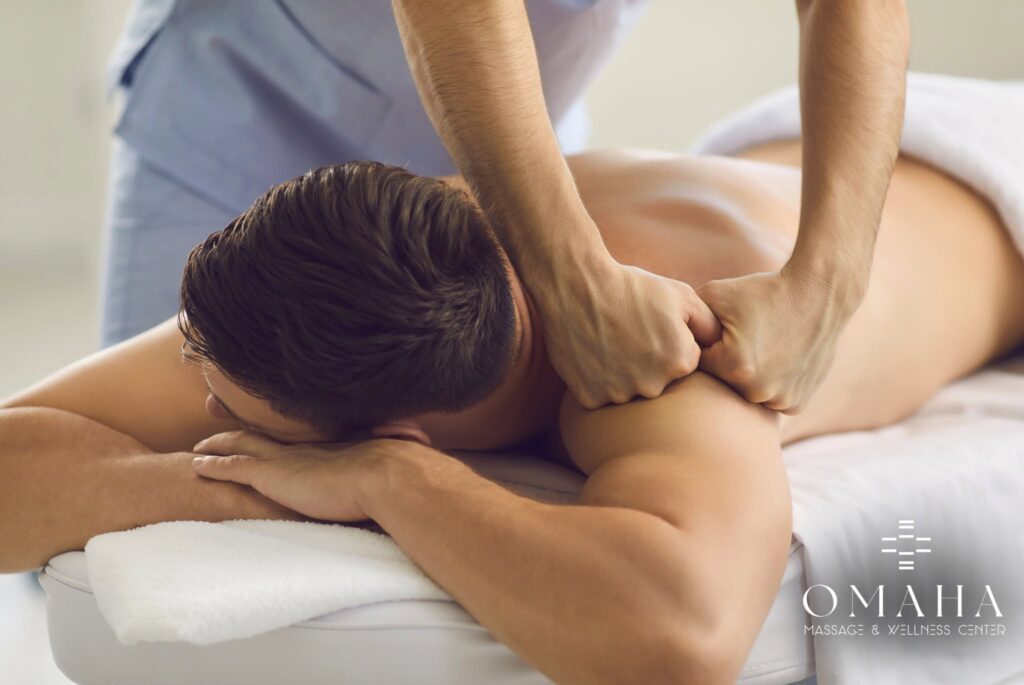
If you’ve been searching “sports deep tissue massage near me,” you already suspect something most casual spa-goers don’t: sports massage and deep tissue massage aren’t the same thing, and the combination of the two is often more effective than either alone. Here’s how we blend them at our Omaha clinic — and how to tell if that blend is what your body needs.
What is sports deep tissue massage?
Deep tissue sports massage merges two approaches. From deep tissue massage, it borrows slow, deliberate work into the deeper layers of muscle and fascia. From sports massage, it borrows the activity-specific focus: instead of a uniform full-body routine, the session concentrates on the tissue your training, sport, or physical job actually overloads. The result is deep work with a purpose — pressure applied where your movement patterns say it belongs.
Who benefits most from this combination?
In our experience, three groups get the most out of a deep sports massage:
- Athletes in heavy training blocks whose tightness has moved past “sore” into “restricting my range of motion”
- Adults returning to activity after time away, when old compensation patterns resurface fast
- Physical workers — trades, healthcare, warehouse — whose bodies take athletic loads without athletic recovery routines
If your main goal is stress relief and relaxation, this probably isn’t your session; something gentler will serve you better, and we’ll say so at intake.
What does the session actually feel like?
Expect focused, sustained pressure, active communication, and sometimes movement — we may ask you to slowly flex or extend a joint while we work the tissue around it. Discomfort should stay at the “productive” level: intense but breathable. As the Mayo Clinic notes in its overview of massage therapy, massage is generally safe when performed by a trained professional, and communicating about pressure is part of getting it right. Our owner, Shelah Hinton, has practiced since 2010 and is currently pursuing a Master’s in Myoskeletal Alignment Techniques through Erik Dalton’s Freedom From Pain Institute — advanced training focused precisely on why the same spots keep tightening and what actually resolves it.
How is this different from just asking for “more pressure”?
This is the founder insight we repeat constantly: depth is not a dial, it’s a destination. Untrained “more pressure” bruises tissue and makes it guard harder. Trained deep work warms and prepares the outer layers first, then sinks in gradually so the muscle lets the therapist in. If a previous deep massage left you wrecked for three days, the depth wasn’t the problem — the pacing was.
Why choose us when searching sports deep tissue massage near me?
Because the “near me” part matters less than the “who.” Every therapist here is licensed in Nebraska and Iowa, and deep tissue and myofascial work are listed specialties for our team — you can verify exactly who does what on our therapist bios. For a broader look at how deep work fits into lasting relief, our guide to deep tissue massage in Omaha covers the full picture.
Sports deep tissue massage FAQs
Will I be sore afterward? Possibly, for a day or so — similar to a workout. Water and light movement help.
How long should the session be? For focused work on one or two regions, 60 minutes is usually right; for multiple areas, consider 90.
Can I train the same day? We recommend keeping the rest of the day light and saving hard efforts for tomorrow.